
Seed red 0,1 %
Kernechtrot is used as a counterstain in many standard stains, such as PAS (Periodic Acid-Schiff), Berliner blue, or silver plating. The use of nuclear red as a counterstain allows differentiated visualization of cell nuclei and other structures, facilitating their identification and examination under the microscope.
Article no.: 10264
Staining of tissue samples

product information
Relevant Ingredients:
• Aluminium sulphate hydrate • 14 H2O
• Nuclear fast red (C.I.: 60760)
•
Instructions / Protocol / Recommendations
Verwendung:
This Nuclear Red 0.1% solution is used in in vitro diagnostics for staining tissue samples. It allows improved visualization and differentiation of cellular structures and tissue components to facilitate detailed analysis and interpretation of samples. This can be helpful in the diagnosis of cellular changes, diseases or disorders and makes a valuable contribution to medical research and clinical practice.
Prinzip:
Kernechtrot 0.1 % solution consists of distilled water, aluminum sulfate hydrate, Kernechtrot, sodium benzoate and is prepared by filtration. In in vitro diagnostics, this solution is used as a staining agent for staining cells and tissues in order to analyze their structure and morphological properties under the microscope. The nuclear red binds to specific cellular components, while aluminum sulfate fixes the stain and sodium benzoate acts as a preservative. Examination of stained specimens allows detailed visualization and identification of cell structures to detect disease or changes in tissue.
Verfahren:
Kernechtrot 0.1 % solution consists of distilled water, aluminum sulfate hydrate, Kernechtrot, sodium benzoate and is prepared by filtration. In in vitro diagnostics, this solution is used as a staining agent for staining cells and tissues in order to analyze their structure and morphological properties under the microscope. The nuclear red binds to specific cellular components, while aluminum sulfate fixes the stain and sodium benzoate acts as a preservative. Examination of stained specimens allows detailed visualization and identification of cell structures to detect disease or changes in tissue.
Hazard and safety instructions
| Signal Word 1: Gefahr |
| Signal Word 2: acid_red, , , |
Warning labels: 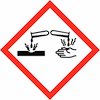 |
Suggested products
-
Staining kit: Alcian blue-core red for acidic mucosubstances
Detection of mucopolysaccharides
Article number: 13416from € 64.34 + VAT
Staining Kit: PAS-M Staining after JONES
Staining of basement membranes in kidneys
Article number: 17254from € 205.68 + VAT
Dyeing kit: Silvering according to von KOSSA (KRUTSAY)
Neurofibril staining
Article number: 16764from € 149.07 + VAT
Staining kit LH: Staining according to BAUER and CALLEJA
Food sample staining
Article number: 14640from € 43.31 + VAT
Dyeing kit LH: Silver impregnation according to GROCOTT
Food sample staining
Article number: 14646from € 143.94 + VAT
Staining kit LH: LUGOL staining
Food sample staining
Article number: 14634from € 23.35 + VAT
Staining kit LH: CALLEJA staining
Food sample staining
Article number: 14586from € 18.66 + VAT
Dyeing kit: GALLYAS dyeing
Detection of Alzheimer plaques
Article number: 13131from € 176.15 + VAT
Staining Kit: Prussian Blue [Iron(III) Detection]
Iron detection
Article number: 11097from € 55.45 + VAT
Dyeing kit: AZAN according to GEIDIES
Staining of tissue samples
Article number: 12082from € 40.63 + VAT
Staining kit: Victoria blue stain for hepatitis B antigen
Detection of hepatitis B antigen
Article number: 10261from € 65.25 + VAT